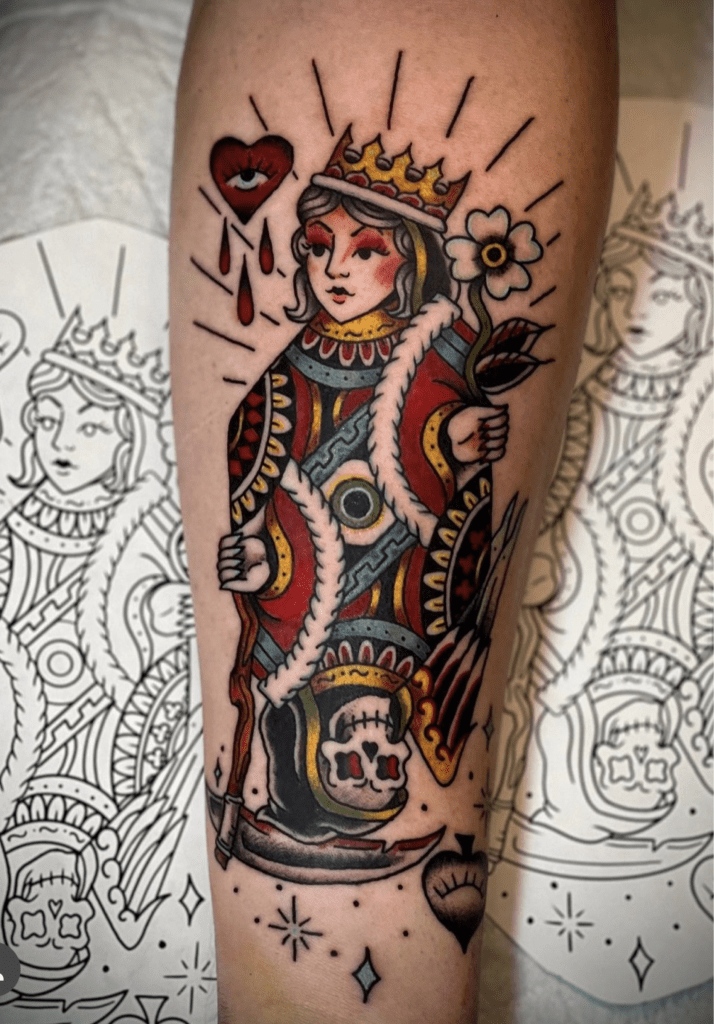
Brilliant and dramatic colors, often in tones that recall Victorian velvets, lush gems, or hues of autumn’s fallen leaves, merged with lavish details like pearls and fine lace – this is often Ink Fanatic what comes to mind when one thinks of the Neo-Traditional style. Perhaps the most extravagant aesthetic in tattooing, this particular style blends the techniques of American Traditional with a more modern and dimensional approach. In this guide, we examine the history, influences, and artists who call the Neo-Traditional method their own.
History and Influences of Neo-Traditional Tattooing
Though it may sometimes seem a far cry from American Traditional style, Neo-Traditional actually does keep in line with many of the technical rules of traditional tattooing. Though line width and weight may vary, black outlines are still standard practice. Clarity of composition, the importance of a black carbon barrier to hold color, as well as shared themes are some of the commonalities. Where Neo-Traditional tattoos tend to differ from Traditional is in their more intricate detailing, depth of image, and their unconventionally varying, vibrant color-palette.
Perhaps the first historical artistic movement that is immediately apparent in the Neo-Traditional style is Art Nouveau. But to understand Art Nouveau, one must first understand the context and symbolism behind that which sparked the movement to flourish.
In 1603 Japan had closed its doors to the rest of the globe. The floating world was intent on protecting and preserving their culture which, due to pressure from outside forces, was being greatly threatened. However, over 250 years later, in 1862, forty Japanese officials were sent to Europe to discuss the opening of Japan’s closely guarded gates. In order to ease tensions between countries, and sustain healthy trading relationships, goods from the two countries began to cross oceans and lands to eagerly awaiting fingertips.
The interest in Japanese goods was almost fetishistic in Europe, and the craftsmanship of the country came to greatly influence future artistic aesthetics. In the late 1870’s and 80’s one can see Japanese artwork greatly informing the works of Monet, Degas, and Van Gogh.
Using flattened perspectives, patterns, and even props such as painted fans and beautifully embroidered kimono, masters of Impressionism eagerly adapted Eastern artistic philosophies into their own work. Van Gogh is even quoted as saying, “We wouldn’t be able to study Japanese art, it seems to me, without becoming happier and more cheerful, and it makes us return to nature…” This influx of Japonisme, and a return to nature, was to spark the next movement to have the greatest effect on contemporary Neo-Traditional tattooing.
 Site Title
Leave a comment